
This site is no longer updated

Please use the links in the sidebar to visit the new sites!

Showing posts with label Mebyon Kernow. Show all posts

Monday, 10 March 2014

Towards a Cornish Assembly?

Cornish nationalist party, Mebyon Kernow, recently launched a
consultation on the format of Cornish devolution.
(Pic : Western Morning News)
While most of the constitutional focus in Wales has been on Silk II, and constitutional focus across the UK on the Scottish independence referendum, the fifth nation of the UK has thrown its own hat into the ring.

Cornish nationalist party, Mebyon Kernow (MK), launched a consultation document on proposals for a devolved Cornish Assembly on March 5th – St Piran's Day. It's available here (pdf).

Fifty thousand Cornishmen will know the reason why

As I've covered before (The Case for Cornwall), Cornwall meets most of the standard requirements and historical precedents to be considered a nation rather than an English region or county. Back in 2001, more than 50,000 signed a declaration calling for Cornish devolution. It was Liberal Democrat policy, with the closest Cornwall coming to devolution being a backbench Government of Cornwall Bill (pdf) introduced by Dan Rogerson MP (Lib Dem, North Cornwall) in 2009.

As I post this, the Lib Dems have made it official party policy again.

Many of the problems facing Cornwall are very similar to those facing
us in Wales  - especially in terms of economic development
and demographic change.
(Pic : BBC)

With the UK constitution now in flux, MK believes "there needs to be a mature, respectful and wide-ranging debate about the future of the whole of the UK and how it is governed." A constitutional convention then - something our First Minister and others in the National Assembly would no doubt agree with.

If it's agreed that Cornwall should see devolution, and a detailed proposal fleshed out, MK supports holding a referendum.

Many of the challenges facing Cornwall are all to familiar to us in Wales : an ageing population caused, in part, by in-migration of retirees; high house prices in rural areas, a relatively weak economy (Cornish GDP per capita was 61.2% of the UK average in 2012, compared to 72.3% for Wales) and "peripheral neglect" by being so far from Westminster.

Except, of course, Wales, Northern Ireland and Scotland have their own devolved legislatures to deal with some of these issues to varying degrees of success (or failure).

MK believe a Cornish Assembly would "be in a strong position to built a more prosperous economy....support Cornwall's traditional and emerging industries, build on Cornwall's sense of place, it's unique brand, and maritime potential".

Chuckles' "Prince of Wales" title is exactly that - a title and nothing more.
His role in Cornwall, however, is significantly more hands on
- perhaps to Cornwall's detriment.
(Pic : The Telegraph)

The party also believe that Cornwall suffers from a "democratic deficit" as they only have 123 councillors serving a population of 534,000 in a single unitary authority. Devon has two and a half times the population but four times the councillors, while Somerset has 1.7 times the population and 3.5 times the number of councillors.

A National Assembly would also reinforce Cornwall's national status, with 73,200 people describing themselves as Cornish in the 2011 census, despite it not being on the official census form, working out at around 14% of the population. Also, 46% of children in the 2013 school census described themselves as Cornish (more from Cornish Republican).
There's a very specific bone of contention too involving the Windsor clan. Chuck Windsor (and presumably in the short to medium term, Billy Windsor) enjoys near-feudal rights as Duke of Cornwall. MK believe devolution will make it easier to hold a full inquiry into "Cornwall's ambiguous constitutional relationship with the Crown and contradictions between this....and administrative arrangements".


What would a National Assembly of Cornwall look like?

Mebyon Kernow propose something for Cornwall near enough identical
to what we have in Wales, with some key differences - in particular the voting system.
(Pic : cornwallvsf.org)
  • Devolved powers – Effectively the same powers as the Welsh Assembly (agriculture, tourism, health, education, culture, housing, local government etc.) - including primary law-making powers from the start. They also want the power to vary income tax, perhaps in light of what's on the table for Wales and Scotland.
  • The Cornish Assembly – 40 Assembly Members (AMs) elected in multi-member constituencies by Single Transferable Vote (STV). This works out as roughly 1 AM per 13,350 people. The exact arrangements and constituencies will be decided by a special commission. Cornish AMs would sit in committees and work in a similar way to our AMs. Although there's nothing in the proposal about where a Cornish Assembly would be based, you would presume it would be at the existing Cornwall Council buildings in Truro without the need for a new building.
  • Cornish Government – Made up of between 4 and 6 ministers with "a small number of junior ministers". It would be headed by a First Minister along the same lines as the Welsh Government and supported by a civil service.
  • Finance – Cornwall would be funded via a Welsh-style block grant via a needs-based settlement, which MK estimate at being in the region of £4billion. They also want control of EU Structural Funding (Objective One), which Cornwall receives in the same way as West Wales & The Valleys, except it's administered from London and Bristol.
  • Local Government Reorganisation – The single local authority covering Cornwall would be rescinded and replaced with four new councils, each with 35-45 councillors, set out by legislation. These councillors would also be elected by STV. Some decisions could be devolved further down to community and parish councils.
  • External Relations – Cornwall should have representation on the British-Irish Council, and should have its own MEP, with offices in Brussels. Cornwall should also have its own Commonwealth Games team and the Cornish should be protected via the Convention for National Minorities in the same way as the Welsh and Scottish.


Devolution : Go for it, but don't repeat our mistakes

If a Cornish Assembly were formed,  these signs might have
more than a little bit a truth in them for once.
(Pic : libdemvoice.org)
Wales stands testament to the fact that while devolution does bring a means to make sometimes significant policy changes, it doesn't guarantee success, and is far from a "magic bullet" in itself.

Believe it or not, Mebyon Kernow have been "inspired" by some of the achievements of our National Assembly over the past 15 years (and the Scottish Parliament), picking out :

  • Scrapping prescription charges and hospital car parking charges.
  • Protection from the "creeping privatisation of the NHS in England".
  • Statutory waste and recycling targets with an aim of "zero waste".
  • Allowing suspension of "right to buy" in areas facing housing pressures.

So there are plenty of things the Cornish can learn from devolution elsewhere in the UK, but there are also plenty of mistakes they would do well not to repeat. I would pick out mismanagement of EU funds as the biggest lesson Cornwall could learn from Wales, as well as timidity in policy making and having too small a legislature to allow effective criticism of the executive.

Politically-speaking, a Cornish Assembly could throw up some interesting things.

If you want to compare it to Wales, it's likely the Lib Dems and Labour would swap positions, with Cornwall becoming a Lib Dem hegemony and Labour being a minor party that would struggle to get more than 3/4 seats in a 40-seat legislature. It would make the machinations of an STV system interesting for psephologists I suppose – and it's sensible that Mebyon Kernow have proposed that system from the start.

As to how to get in the position of being able to hold a referendum, MK would have to secure their "Gwynfor moment". By that I mean winning, or seriously challenging for, a Westminster seat. Then the party would probably have to become a major force on Cornwall Council, being in a position to form a government or some sort of coalition with the Lib Dems in order to get Cornish devolution on the Westminster agenda.
Wednesday, 8 August 2012

The case for Cornwall

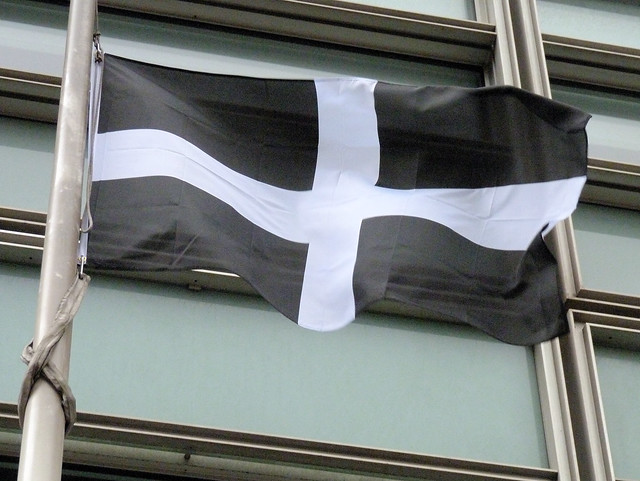
A national flag, or a "regional" one?
(Pic : Via Flickr)
We've often heard that Wales is England's biggest county. It certainly feels like it's treated like that sometimes, but I don't think that quip holds much water anymore other than as a wind-up, especially since devolution – however weak a settlement it is.

There are campaigns for some form of English devolution - and there will have to be movement there at some point in the future. As arguments over the future of the British constitution "rage" (or become totally bonkers in the case of this guy), there are two broad parts of the islands left out of the debate : the Crown Dependencies (which are enjoying what most of us would call "Devo-Max") and the fifth Home Nation – Cornwall.

Wales & Cornwall : Points of divergence

Could this simple act - the creation of a disestablished church - have
changed  Wales' future vis-a-vis Cornwall?
(Pic : Wikipedia)
Wales and Cornwall had a similar relationship with Old England. Both (you could probably expand this to include Devon) were recognised as holding some sort of "separateness" from England proper – both containing the Germanic "wahl" (foreigner) in their adopted names - but being nothing more than vassals to be divided amongst the Norman aristocracy. Subsequent interbreeding with the "natives" created Cambro-Norman and Corno-Norman ruling elites.

Then the Welshman, Owain ap Tudur, managed to play way out of his league. Many years down the line, we ended up with the Tudor dynasty, who centralised rule from London, fully absorbing both Wales and Cornwall into the Kingdom of England.

Both had rebel leaders who wanted to do things differently at varying times – for Owain Glyndwr, see Michael An Gof. Both, however, were fighting powers beyond their control. That power being the carrot dangled in front of our elites that their fortunes could only be made by being fully paid up members of the British project – cemented by the ascension of a Scottish King to the English throne. Both were true to this for some time, being Royalist strongholds through the English Civil War.

Both had their own forms of devolution – the Council of Wales and the Marches, and the Cornish Stannary Parliament. Both were eventually swept away. Both had their own extractive industrial booms – Wales had coal, iron and slate, Cornwall had tin and copper. As a result of industrialisation, both saw increased migration, and both saw the slow decline of the remnant native language and culture. Both were hotbeds of non-conformism and "rural liberalism".

But then something happened that I believe is critical – Wales was treated as a distinct nation. We got our disestablished church and freedom of thought and administration in such matters, while Cornwall was destined to become the "most un-English of English counties." From this, Wales eventually claimed administrative, then legislative devolution. But for Cornwall, the damage had been done.

The Cornish have, to date, never had their "1955 moment". Cornwall isn't widely considered in equal standing with the "four" Home Nations, though attitudes are changing.

Cornwall doesn't have a national rugby team, national football team, Commonwealth Games team, national university....the list goes on. These are things the Welsh take for granted, as they've "always been there", and we couldn't possibly imagine them being taken away now.

Welsh nationalists probably won't admit this, but I'll be honest – Cornwall is a worst case scenario of what Wales could've been. Administratively, Cornwall has been absorbed into England and has had very few, if any, symbols of nationhood besides its flag, the Cornish language and national anthem.

Maybe that's all you do need. A sense, or idea, of nationhood can never be taken away. Cornwall is slowly but surely being revived, and that should enhearten civic nationalists everywhere.

Cultural Revival

The unedifying spectacle of the Cornish flag being taken forcefully from an Olympic torchbearer back in May prompted significant outrage, resulting in an overturning of a ban on the flag of St Piran at the Olympic Games themselves. You've probably noticed yourselves, but this has been extended to Y Ddraig Goch too.

On the civic culture side of things, a Cornish national theatre is proposed by Cornwall Council as part of a wider plan on Cornish culture. Alongside this, a Cornish National Library is also planned to house various documents currently split between several sites. That's a lot of "nation building" there.

The Cornish language (Kernewek, or in Welsh, Cernyweg) is seeing a gradual revival, with between 2-3,000 people estimated to be able to hold a conversation or be fluent in the language. Cornish, Welsh and Breton share a similar Brythonic language family, and although Welsh and Cornish are very similar, they aren't entirely mutually intelligible. UNESCO has Cornish listed as a "critically endangered" language (Welsh is listed as "vulnerable"), but Cornish has, at least, been upgraded from the incorrect "extinct" designation.

Cornwall has always maintained a distinct culture, and
against all odds, a distinct language too.
(Pic : Wikipedia)
Reaching a eventual milestone of, for example, "10,000 speakers" would be remarkable considering where the language was - aided by projects like Radyo an Gernewegva (Cornish-speaking area Radio) and organisations like Maga (the Cornish equivalent of the now-defunct Welsh Language Board). Cornwall is still some way away from becoming a bilingual nation, but keeping Cornish alive in these circumstances is an achievement in itself.

In another big step - literally within the last day or two - Visit Cornwall have dropped references to "England" and "county" from their promotional materials. They're adopting "region" (softly) for now, and will probably keep "Duchy" to spare Chuckle's feelings, but how long until that becomes "country"?

Political Revival

You're right Dave, it might not be the Amazon, but
it's still a national border.
(Pic : National Archives)
There have been three incidents that have provoked Cornish self-awareness in more recent times.

Firstly, the creation of a "Devonwall" constituency in the proposed Westminster boundary reforms. Recent events mean that might not happen now, but it reeks of a decision taken by a government that fails to take local - or in this case, national - opinion into account.

Now, imagine the reaction in Wales if Monmouthshire, or parts of Powys, were partially merged with Marches seats, and the Prime Minister justifying it by saying, "It's the Severn, not the Amazon, for Heaven's sake!" That would be unthinkable, wouldn't it?

The rational reason to oppose such a move would be that, because of devolution, it would make the role of any prospective MPs too complicated – but the obvious, sentimental "heart" reason would stir sentiments more. Cornwall doesn't have that luxury (for now).

Secondly – the proposed "pasty tax". Now the spectacle of politicians of all colours winding themselves up over pastries might have been very "Brass Eye", but the Cornish pasty is an EU-designated protected geographical product. It was estimated by the Cornish Pasty Association that the "pasty tax" would've led to "400 job losses and a £100million hit." The u-turn might well have been a shambles, - leading to unnecessarily complicated rules on VAT - but it could be considered a minor victory for the Cornish food industry.

Thirdly - a sports stadium. A 10,000-capacity stadium for Cornwall was proposed on the outskirts of Truro for promotion-chasing Cornish Pirates RFC (the Cornish like rugby almost as much as the Welsh do) and Truro City FC. Plans have been on and off for the best part of a decade, but in the last few years were revised, not as a "Stadium for Truro", but as a "national", popular campaign for a "Stadium for Cornwall". Although the bid has been put on the back burner due to funding issues, it was a perfect melding of the cultural with the political – a home for, what effectively is, a "national" sports team, and a significant "political" investment in sporting facilities alongside it.

There's one other depressing characteristic Cornwall and Wales share – rural poverty. Cornwall is an Objective One area in the same way West Wales & The Valleys is, with a GVA per capita around 70% of the UK average. However, the Cornish have been partially successful in closing the gap. Can Wales learn from what the Cornish have done there?

Having said that, Cornwall had no sway on Objective One decisions. It was managed within the South West England region, while Wales is a European region of its own and manages European programmes largely by itself.

The creation of Cornwall Council (as a single unitary authority) in 2009 has been viewed quite negatively since it replaced six, smaller, district councils. Maybe this creation of a pan-Cornish institution will make the path to devolution much easier – and the local government situation can always be resolved post-devolution. Indeed, a Government of Cornwall Bill was introduced by a backbench Liberal Democrat in 2009, but nothing came of it.

Cornwall is a traditional Liberal Democrat stronghold (along with much of south west England), with the Tories a competitive second party. Labour are practically non-existent outside of the major population centres. The Cornish Nationalist party, Mebyon Kernow, has been a fully-fledged political party for some 40 years, and has 5 seats in the 123 member Cornwall Council, as well as many representatives at community and parish level. They campaign for Cornish devolution, wishing to create a devolved Cornish Assembly, with the same powers - broadly - as the Welsh Assembly.

A devolved, or de-loved future?

The future "Senedh Kernow"?
(Pic : BBC)
Wales and Cornwall share an awful lot in common, including being caught in Westminster's blind spot when it comes to our more peripheral needs.

But the Cornish shouldn't expect devolution to act as a magic bullet. It'll have its disappointments, and it'll have its triumphs – like all forms of government. It'll probably have to be a process led by the Liberal Democrats if anyone - or, perhaps at some point in the future - Mebyon Kernow MPs.

Cornish Nationalists don't need to be patronised by people like me. They might be starting off the process further behind Wales, but they have more than enough raw material to work with and a strong case to be made for equality with the other Home Nations. It's hard to predict when, or if, Cornwall will eventually become a devolved nation - but a nation they are.

And once a nation stands up and actually acknowledges that fact, who knows where it'll take them....